The Discernment Compass
A model for spiritual discernment and decision making.. This Practice draws on a number of traditional Christian approaches to discernment including Wesley’s Quadrilateral, and is modelled on The Daily Examen by St Ignatius of Loyola, founder of the Jesuits..
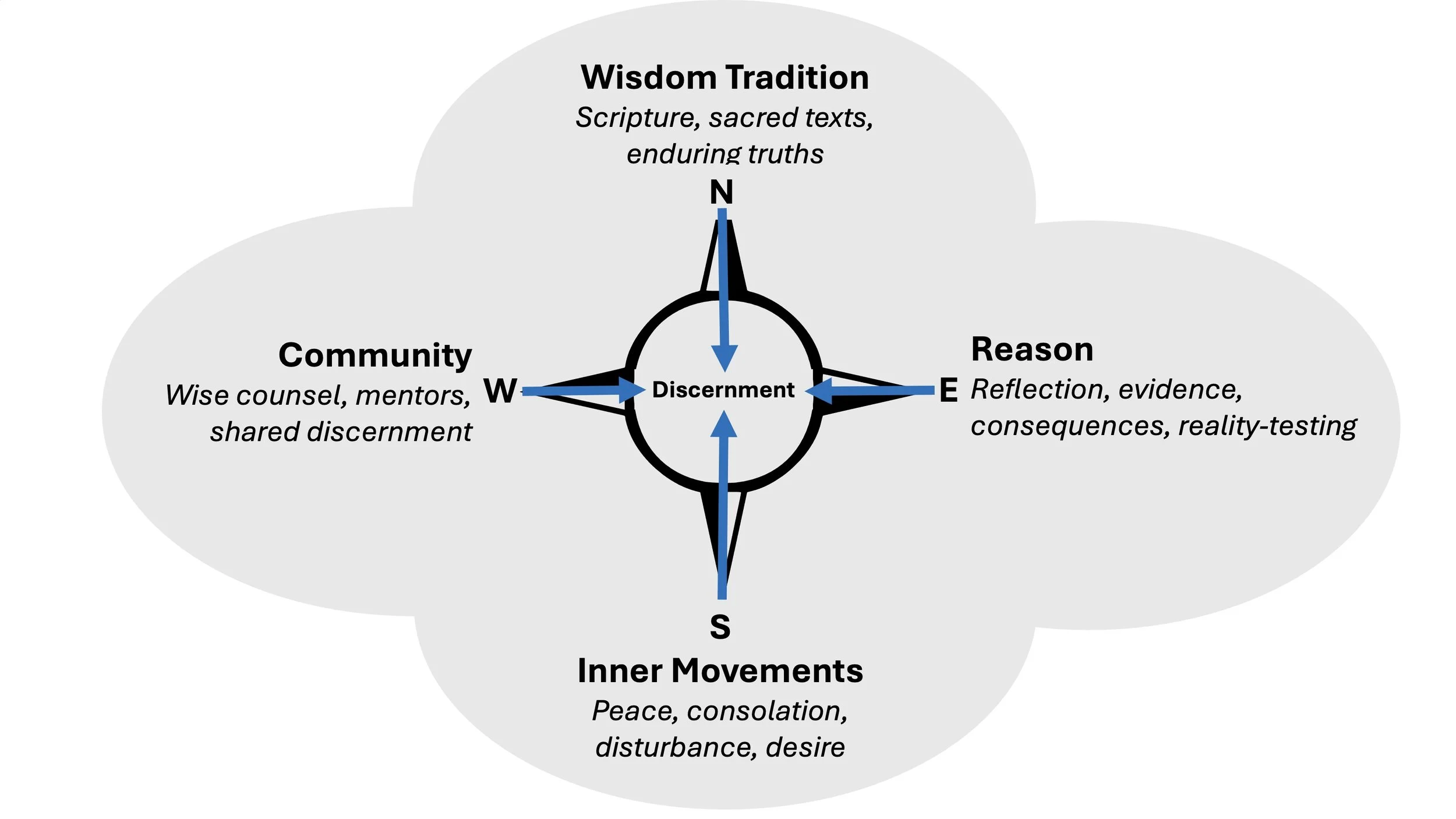
The Discernment Compass: A model for spiritual discernment and decision making. But note that discernment is not certainty, but faithful alignment. Look for convergence across all four directions over time. DR Phelan 2026
Using The Discernment Compass
You could use this:
Daily (5–10 minutes)
Weekly (more reflective)
Before major decisions
Step 1 - Arrival - Become Present
“Be still and know…”

Sit quietly
Breathe slowly
Become aware of God’s presence with you
Now. Here. This.
Prayer : “God, you are already here. Help me to see what is true.”
Step 2 🧭 North - Reflect on Wisdom - Truth & Alignment
Frame the question or matter you are seeking clarity on: ___________________________________
What do I already know to be true?
What do Scripture and my tradition say about this situation?
Is there a particular Bible character, teaching, parable, or scripture passage that comes to mind?
Is there a particular poem, artwork or wise quote that speaks to me about this matter?
What values or teachings are clearly relevant? What do I know to be deeply true?
Is anything here clearly out of alignment with love, justice, or truth?
👉 Anchor yourself before moving forward
Step 3 🧠 East - Apply Reason - Clarity & Reality
What does wise thinking reveal?
What are the actual facts? versus anxious feelings and projections?
What is in my control? Out of my control?
What are the actual options before me?
What are the likely consequences of each? Pros and Cons?
Am I being realistic—or avoiding something?
👉 Name things as they are, not as I wish them to be
Step 4 ❤️ South — Notice Inner Movements - Spirit & Desire
What is happening within me?
Gently notice:
Where do I sense peace, energy, openness, freedom, flow? (Consolation)
What feels “right”?
Where do I feel tightness, fear, confusion, draining? (Desolation)
Is there some aspect that just doesn’t feel right?
Ask:
What draws me toward life?
What drains or diminishes me?
👉 Do not rush—look for patterns over time
Step 5 👥 West — Community - Seek Wisdom Beyond Self
Who can help me see clearly?
Have I shared this with a wise and trusted person?
What feedback or perspective have others offered?
Is there a sense of coalescing of other trusted people’s thoughts? Confirmation—or caution?
Have you had a sense of God showing up or speaking to you through others or nature?
Has something presented itself to you which feels like affirmation of what to do next?
👉 Discernment matures in relationship
Step 6 🔄 Convergence —Listening for Alignment
Where do the four directions begin to coalesce and agree? Is there a direction where:
Wisdom aligns
Reason makes sense
My inner life opens; I feel lighter
Others affirm
👉 When all four begin to align → confidence grows
👉 When one is out of sync → pause
👉 This is often where clarity quietly emerges.
Step 7 👍 Decision —Acting with Trust
Choose with freedom, not fear
Make the best decision you can with what you have
Release the need for perfect certainty
Sometimes there are several acceptable ways to go. Having considered the four compass perspectives - focus less on the fear of making the wrong decision, and more about making your decision right.
Prayer: “God, I choose this path in trust. Walk with me on it.”
Step 8 🍇 Review — Fruit Over Time
Discernment continues after the decision. Over days/weeks, notice:
Does this bring deeper life, love, and coherence?
Or confusion, contraction, and dis-ease?
👉 Jesus’ principle: “By their fruit…”
Closing Thoughts
“Discernment is not about finding a perfect plan, but about becoming a person who can recognise and respond to life with wisdom, love, and trust.”
"A simple rule of thumb… If it doesn’t sound like, feel like, resemble, or resonate with ‘Heaven’ then what the hell are we doing?” John Sharpe - In the Bubble and the Squeak 2026
See also: The Still Point Practice
For a Deeper dive
1. ✝️ Christian Models of Discernment
👉 The Wesleyan Quadrilateral – A Balanced Framework
Associated with John Wesley. Four sources for discernment:
Scripture – Primary authority
Tradition – Wisdom of the Church through history
Reason – God-given rational reflection
Experience – Personal and communal encounter with God
Strength: Balanced, accessible, intellectually and spiritually integrated
Risk: Over-weighting experience or reason can distort
In practice: Discernment becomes a convergence process—when these four align, confidence grows.
👉 Ignatian Discernment – Interior Movements
Developed by Ignatius of Loyola. Ignatius focused less on external rules and more on inner spiritual movements.
Consolation→ movement toward God (peace, clarity, love)
Desolation→ movement away (confusion, anxiety, fragmentation)
Core practices:
Daily Examen
Noticing patterns over time
“Testing the spirits”
Making decisions in a state of inner freedom (holy indifference)
Strength: Deep psychological and spiritual realism
Risk: Misreading emotional states without guidance
In practice:Discernment is less “What is the right answer?” and more “Where is the Spirit drawing me into deeper life?”
👉 Monastic / Benedictine Discernment – Communal Wisdom
Rooted in Benedict of Nursia and the Rule of St Benedict. Features:
Listening (Obedientia = deep listening)
Stability and patience
Community discernment
Attention to the “still small voice”
In practice: Decisions are not rushed. Truth emerges throughtime, prayer, and community
👉 Quakers (the Religious Society of Friends)
The Quaker tradition (the Religious Society of Friends) offers a distinctive, deeply communal approach to discernment grounded in attentive silence and the belief that the “Inner Light” of God is present within each person. Rather than seeking decisions through debate or majority vote, Quakers gather in stillness—often in what is called a clearness committee or discernment circle—where a small group listens prayerfully together.
The focus is not on giving advice or solving a problem, but on asking gentle, open questions that help the individual listen more deeply to the movement of truth within. Periods of silence are central, allowing space for insight to emerge. Discernment is recognised not as personal preference, but as a shared process of waiting upon the Spirit, trusting that clarity will arise through collective attentiveness, humility, and patience. In this way, Quaker discernment reflects a profound confidence that truth is discovered not through striving, but through listening together in the presence of God.
👉 Reformed / Evangelical Discernment Approaches
Often emphasise:
Primacy of Scripture
Prayerful seeking
“Open and closed doors”
Inner sense of calling
Strength: clarity and conviction
Risk: overconfidence in subjective certainty (“God told me…”)
👉 Pentecostal / Charismatic Discernment
Guidance through Holy Spirit impressions
Words of knowledge, prophecy
Communal confirmation
Strength: immediacy and expectancy
Risk: lack of testing/grounding if not held in community
✡️ 2. Jewish Approaches to Discernment
Judaism rarely frames this as “finding God’s specific plan” in the same way.
Instead, it emphasises faithfulness to Torah and wise living.
👉 Halakhic Discernment (דרך החיים – “the way of walking”)
Rooted in Torah and Talmud
Interpreted through rabbinic tradition
Applied to real-life situations
Discernment = “What is the faithful action here?”
👉 Rabbinic Reasoning & Debate
Dialogue and argument (machloket)
Multiple perspectives held in tension
Truth is often plural and relational, not singular and absolute
👉 Mussar Movement (Ethical Discernment)
Focuses on:
Character formation (humility, patience, justice)
Self-examination
Discernment comes through becoming the kind of person who chooses well
👉 Kabbalistic / Mystical Discernment
Attunement to divine presence (Shekhinah)
Symbolic and contemplative awareness
Less about decisions, more about alignment with divine flow
☪️ 3. Islamic Approaches to Discernment
👉 Istikhāra – Prayer for Guidance
A central practice in Islam
Specific prayer asking Allah for guidance in a decision
Followed by attentiveness to outcomes and inner ease
Not about visions necessarily—more about clarity and unfolding ease
👉 Shura – Consultation
Seeking counsel from wise others
Community-based discernment
Echoes Benedictine and Wesleyan communal wisdom
👉 Use of ‘Aql (Reason) + Revelation. A Balance of:
Qur’an
Hadith
Reasoned judgment
Similar to Wesley’s integration of Scripture + Reason
👉 Sufi Discernment (Mystical Islam)
Inner purification of the heart
Guidance from a spiritual teacher (sheikh)
Sensitivity to subtle movements of the soul
Very close to Ignatian awareness of inner movements
🌍 Cross-Tradition Patterns (A Synthesis)
Four recurring dimensions of Discernment:
1. 📜 Revealed Wisdom
Scripture, Torah, Qur’an
Foundational anchor
2. 🧠 Reflective Wisdom
Reason, interpretation, theology
Wrestling with meaning
3. ❤️ Inner Awareness
Movements of the heart
Peace vs disturbance
Conscience
4. 👥 Communal Confirmation
Spiritual directors
Community
Tradition
Three converging markers of discernment:
Alignment with love and truth (not fear or ego)
Increasing inner coherence (even if not comfort)
Fruit over time (does it lead to life?)
Final Reflection
🌿 A Deeper Answer to the Core Question: “How can we be sure and certain?”
It seems that the deepest wisdom of the great traditions gently shifts the question:
To not: “How do I get certainty?”
But rather: “How do I grow in faithful responsiveness?”
Perhaps the deepest shift across the traditions is this: Discernment is not primarily about finding a hidden blueprint, but about becoming a person who can walk faithfully with God in uncertainty
Which, interestingly, aligns with the “Hero → Wise Elder” arc:
The Hero seeks the right path
The Elder trusts the way itself