THE STILL POINT Discernment Practice
A Guided Practice (15-25 minutes)
© DR Phelan - Uplift Centre 2026
At some point, whether in moments of decision or seasons of uncertainty, a deeper question begins to surface: How do I know the right path to take? 🤔
For some, this question is framed in explicitly spiritual language: What is God’s will for my life?
For others, it emerges more quietly: What feels true? What leads to life? What is mine to do?
Across traditions—Christian, Buddhist, Chinese Taoist, and beyond—this question has been explored for centuries.
And not surprisingly, convergence emerges: Discernment is not primarily about finding a hidden blueprint. It is about learning to see clearly, listen deeply, and live in alignment.
In earlier stages of life, we tend to seek certainty. In later stages, we discover something more subtle—and more trustworthy: Not certainty, but attunement.
What follows is not a technique to master, but a practice to inhabit—a way of walking through life with increasing clarity, freedom, and trust.
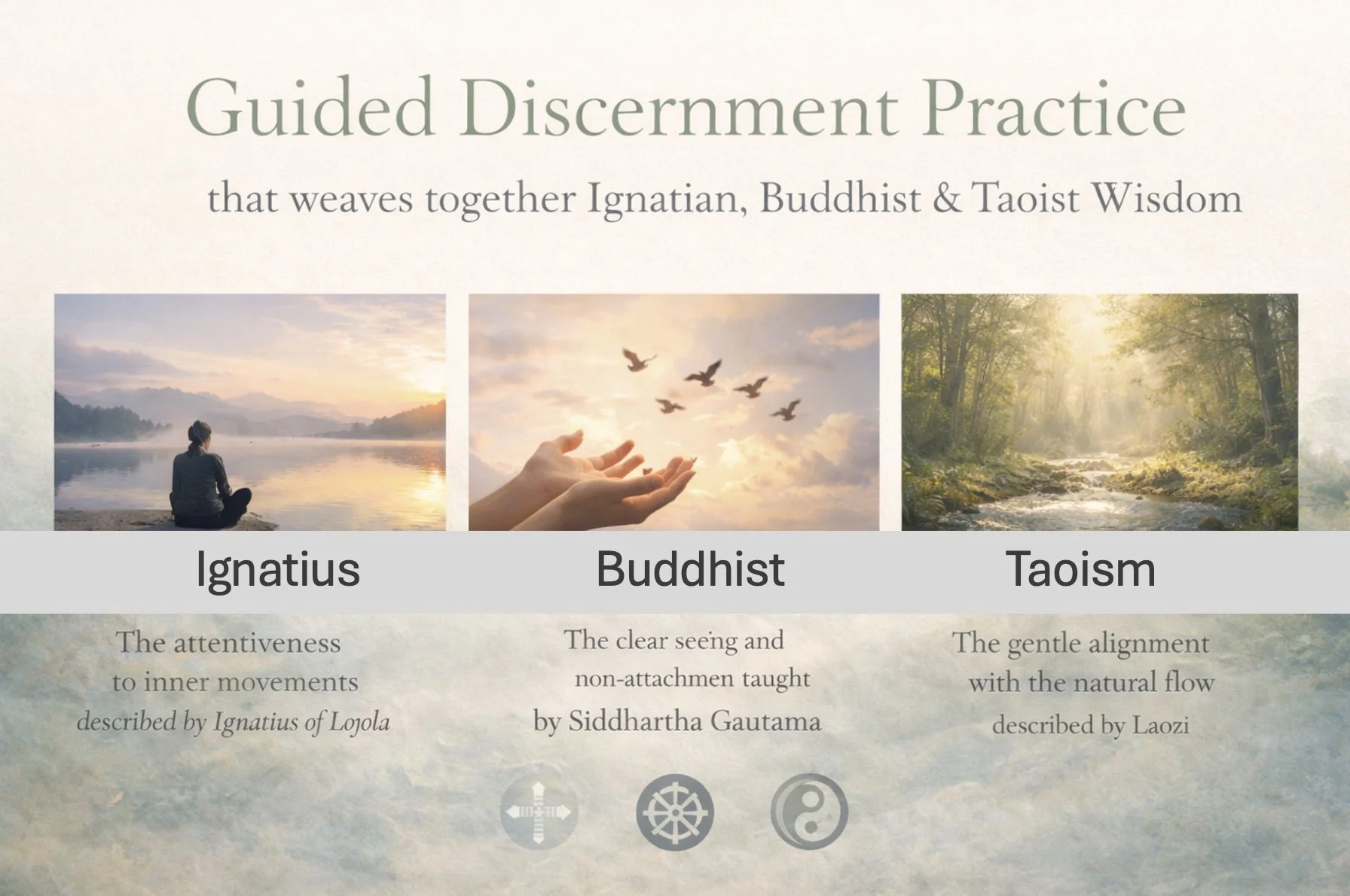
Walking the Path from Choice to Alignment
This practice is an 8 step Guided Discernment Practice that weaves together Ignatian, Buddhist & Taoist Wisdom:
The attentiveness to inner movements described by Ignatius of Loyola
The clear seeing and non-attachment taught by Siddhartha Gautama
The gentle alignment with the natural flow described by Laozi
1. ARRIVING (2-3 mins) — Be still.

Sit. Breathe. Arrive.
Sit comfortably.
Let your body settle.
Gently bring awareness to your breath:
Inhale… slow… natural
Exhale… releasing tension
Do not try to “get anywhere.”
Just arrive.
Taoist: Nothing to force
Buddhist: Nothing to fix
Ignatian: You are already in God’s presence
“Be still, and know that I am God.” — Psalm 46:10
“The Lord is in his holy temple; let all the earth keep silence before him.” — Habakkuk 2:20
“At the still point of the turning world… there the dance is.” — T.S. Eliot
👉 You are not beginning the journey—you are arriving where God already is.
2. OPENING INTENTION (1-2 mins) — Naming what you hold

What am I bringing? Name your question gently.
Name—silently or aloud—the decision, question, or situation:
“Here is what I am holding………………………………………………”
Then offer a simple intention:
“I desire to see clearly,
to be free from distortion,
and to be led toward life.”
Let this be gentle—not striving, but consenting.
“Search me, O God, and know my heart…” — Psalm 139:23–24
“If any of you lacks wisdom, ask God… and it will be given.” — James 1:5
“Be patient toward all that is unsolved in your heart and try to love the questions themselves.” - Rainer Maria Rilke:
👉 Discernment begins not with answers, but with honest offering.
3. SEEING CLEARLY (5-7 mins) — Observing without grasping

Watch what arises—without clinging.
Bring the situation to mind.
Now notice what arises:
Thoughts
Emotions
Body sensations
Do not analyse yet—just observe.
You might quietly name:
“Thinking…”
“Fear…”
“Hope…”
“Tension…”
Let each arise and pass like clouds.
Ask gently:
What am I attached to here?
What am I afraid of losing?
What outcome am I clinging to?
Let go—not by force, but by softening your grip.
“Test everything; hold fast to what is good.” — 1 Thessalonians 5:21
“To pay attention, this is our endless and proper work.” — Mary Oliver
Buddhist Insight – Observing without attachment
👉Clarity comes not by control, but by attention.
4. SENSING INNER MOVEMENTS (5-7 mins) — Consolation & Desolation

Notice what draws you toward life—and what pulls you away.
Now, gently re-engage the decision.
Imagine one possible path…
Sit with it.
Notice:
Does this bring expansion or contraction?
Peace or agitation?
Clarity or confusion?
Then imagine the alternative path…
Again, notice.
👉 Use Ignatian language:
Consolation → draws you toward life, love, coherence
Desolation → leads to fragmentation, heaviness, disquiet
Don’t rush. Let patterns emerge.
“The peace of God… will guard your hearts and your minds..” — Philippians 4:7
“By their fruit you will know them.” — Matthew 7:16
“May you trust the deepest currents of your own soul.” — John O'Donohue
👉 Not all peace is comfort, and not all discomfort is wrong—look for deeper coherence.
5. ALIGNING WITH FLOW (3-5 mins) — The gentle way

What is unfolding naturally? - Taoist Discernment
Now shift the question:
Not: “What should I choose?”
But: “What is already trying to happen?”
Gently ask:
Where am I forcing or striving rather than flowing?
What feels timely rather than pressured?
What requires less effort but more alignment?
What would happen if I stopped pushing?
Where is there natural ease or energy?
Imagine yourself stepping into each option again:
Which one feels like moving with the current, not against it?
“Trust in the Lord… and he will make your paths straight.” — Proverbs 3:5–6
“My yoke is easy, and my burden is light.” — Matthew 11:30
“Nature does not hurry, yet everything is accomplished.”— Laozi
👉 The way of life often feels less like force… and more like flow.
6. GATHERING THE THREADS (2-3 mins)— Listening inward
Hold together what you have seen and felt.
Hold together three lenses:
🧠 What have I seen clearly?
❤️ What has stirred within me?
🌊 Where is the natural flow?
You might ask:
“If I were free…
if I were not afraid…
if I trusted life…
what would I do?”
Let an answer emerge, not be forced.
“Speak, Lord, for your servant is listening.” — 1 Samuel 3:9
“Let the peace of Christ rule in your hearts.” — Colossians 3:15
“The longest journey is the journey inward.” — Dag Hammarskjöld
👉 Discernment often whispers before it speaks clearly.
7. CONSENT & RELEASE (2 mins) — Letting go into trust

Release the need to control.
Offer your discernment:
“I will take the next faithful step,
and release the need to control the outcome.”
Rest in this.
Ignatian: Trust in God’s guidance
Buddhist: Non-attachment to results
Taoist: Harmony with the unfolding way
“Commit your way to the Lord; trust in him…” — Psalm 37:5
“Not my will, but yours be done.” — Luke 22:42
“Let nothing disturb you,
let nothing frighten you…
God alone suffices.” - Teresa of Ávila:
👉 Discernment matures into trust, not certainty.“Let nothing disturb you… God alone suffices.”
8. CLOSING — Walking the next step

Take the next faithful step.
Before finishing, note:
What surprised me?
What felt deeply true?
What remains unclear (and needs time)?
You may wish to journal a single sentence:
“The next right step is………………”
You do not need the whole path—only the next step.
“Your word is a lamp to my feet, and a light to my path.” — Psalm 119:105
“Those who hope in the Lord… shall renew their strength.” — Isaiah 40:31
“Traveler, there is no path—the path is made by walking.” — Antonio Machado
See also: The Discernment Compass