
Camelot
King Arthur and the journey from young hero to wise elder
A teaching story for our lives and organisations….
©DR Phelan / Uplift Centre 2026
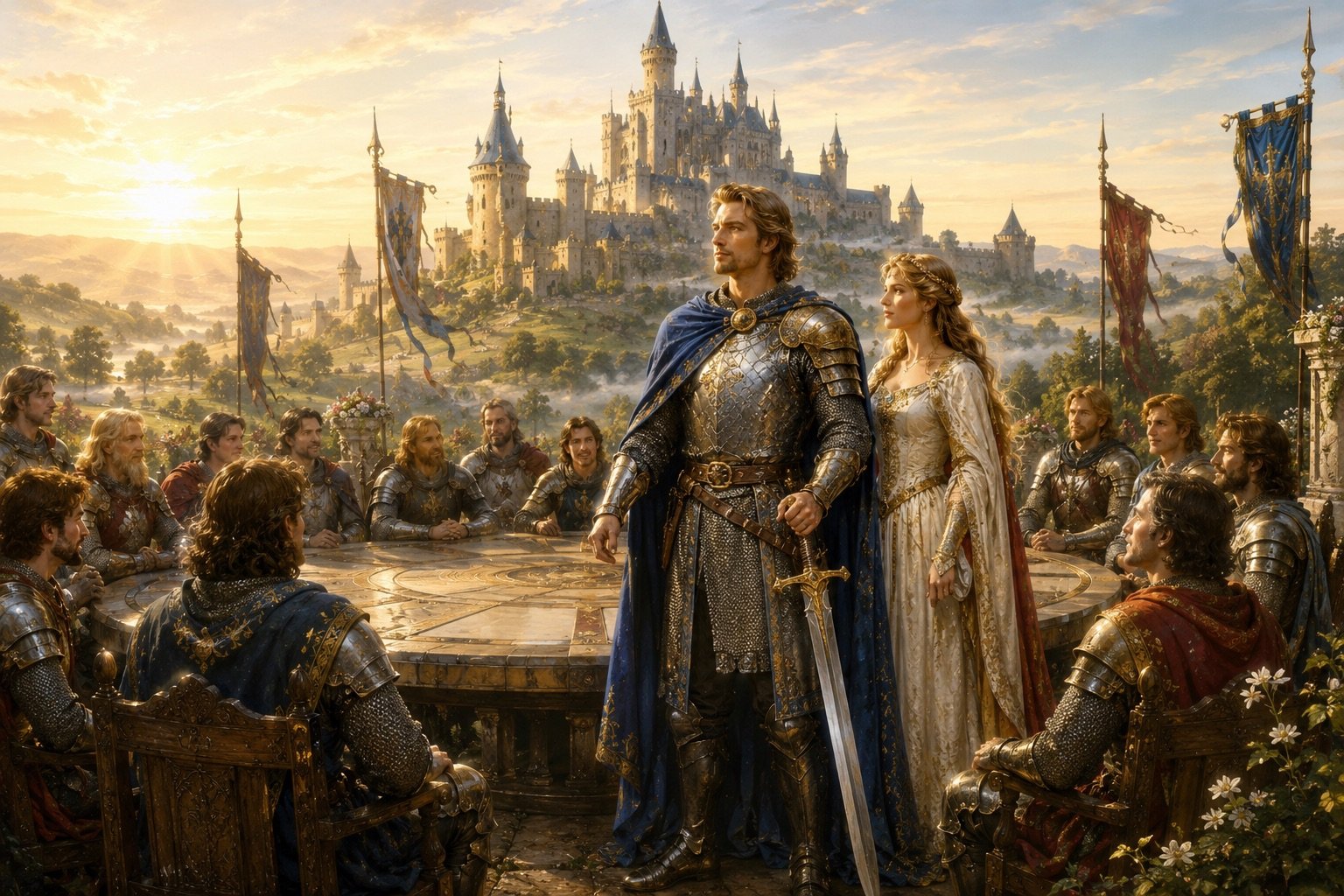
“Don't let it be forgot, that once there was a spot… for one brief shining moment … that was known as Camelot.”
Introduction
When I was a boy I devoured books about King Arthur and the Knights of the Round Table and was swept up by the film of Camelot. I loved the world it opened: Merlin and Excalibur, brave knights riding out on dangerous quests, the search for the Holy Grail, and the hope of a kingdom built on honour and integrity. At the centre was Arthur's great dream - that strength could serve justice and that courageous people could gather as equals around one Round Table.
For a while, the dream comes wonderfully alive. Camelot becomes a place of friendship, courage and shared purpose. But a hidden love grows between Queen Guinevere and Lancelot, Arthur's closest friend and greatest knight. Mordred sees the weakness and uses it. Trust breaks down, the knights turn against one another, and the kingdom begins to fall apart.
That is what makes Camelot much more than an old tale of swords and castles. It is a story about the dreams we build, the people we love, the mistakes that wound us, and what may still be worth carrying forward when a golden season comes to an end.
Arthur's journey from boy to king
The stories of King Arthur were told and retold for centuries, so there is no single version that includes every detail. Yet the main shape is familiar. An unknown boy is called into a much larger life. He meets a wise mentor, faces enemies, gathers loyal companions and builds something remarkable. Then he is forced to face betrayal, failure and loss. In the end, the greatest treasure is not the kingdom he once ruled, but the meaning of the story he can pass on.
Arthur's adventure also goes further than the usual story of a young hero who defeats the enemy and comes home victorious. Arthur grows from boy to warrior, from warrior to king, and from king to the founder of Camelot. Later, when everything he has built begins to crumble, he must learn the hardest lesson of all: how to let go without losing what mattered most.
The hidden child and the call of the sword
Arthur does not begin as a famous prince. He grows up away from the royal court, unaware that he is the rightful heir to the throne. To everyone around him, he is simply a boy called Wart. Then he comes to the sword in the stone. Great and powerful men have tried to pull it free and failed. Arthur draws it out.
In that moment, his ordinary life is over. The sword does not merely give Arthur a crown. It reveals something about him that even he did not know. It is both a call and a promise: You may look like an ordinary boy, but there is more within you. This is who you are being called to become.
Most of our calls are less dramatic. No sword flashes in the sunlight. Yet a new responsibility, an unexpected opportunity, a deep longing or even a painful loss can pull us out of the life we know. The call often arrives before we feel ready. We become a parent before we know how to be a parent. Like Arthur, we may have to begin the journey before we fully understand where it will lead.
A crown does not make a king
Drawing the sword proves that Arthur is the rightful king, but it does not make him a wise one overnight. Many powerful men refuse to accept him. He must face opposition, learn whom to trust and discover how to carry authority without being changed for the worse by it. The sword reveals his calling; the trials ahead must shape his character.
Merlin becomes his guide. He has magic, of course, but his greater gift is seeing further than Arthur can see. Merlin helps the young king understand that ruling is not mainly about wearing a crown or winning battles. It is about deciding what kind of kingdom his power will create.
That is true for us too. Being given a role or title does not mean we have already grown into it. We become a leader, parent, partner, professional or elder through mistakes, encouragement, hard lessons and the help of people who can see something in us that we cannot yet see ourselves.
Camelot the Round Table and the great quests
Once Arthur has united the kingdom, he dares to imagine something new. He has seen a world where the strongest person simply takes what he wants. Arthur wants to turn that old rule around: not might is right, but might for right. Strength should defend and uplift people, restrain cruelty and serve justice.
The Round Table becomes the heart of this dream. A round table has no head seat and no lowest one. Arthur is still king, but every knight has a place, a voice and a duty. The knights are no longer meant to fight for their own fame. They are asked to become a fellowship, using their different gifts in the service of something greater than themselves.
The old order vs Camelot's new way
Might is right vs Might used for right
Power as domination vs Power as service
Personal vengeance vs Impartial justice
Rank and privilege vs Fellowship around a common table
Individual glory vs Commitment to a shared purpose
Violence and impulse vs Courage disciplined by honour
Leadership through fear vs Leadership grounded in trust
Then come the great adventures. The knights ride beyond the safety of Camelot to face enemies, rescue those in danger and test their courage. Above all stands the quest for the Holy Grail - not simply a hunt for a magical object, but a search for something holy, whole and true. The Grail reminds them that the greatest quest is not to become famous. It is to become worthy of what they seek.
The brief shining moment
For a while, Camelot seems to prove that the dream is possible. Old enemies become allies. Law begins to replace revenge. Courage is joined with mercy. The finest knights come to Arthur because they want their lives to mean something.
This is Camelot's brief shining moment - the season when everything seems to come together. We know moments like this in our own lives: a family at its happiest, a friendship at its strongest, a team full of trust, or work that feels deeply worthwhile. We look around and think: This is what I hoped life could be.
But even at its brightest, Camelot is still made up of human beings. The knights are brave, yet they also carry pride, jealousy, longing and old wounds. Arthur has learned how to defeat enemies outside the walls. He has not yet fully learned how to deal with the secrets and divided loyalties growing inside them.
The crack at the heart of Camelot
Lancelot seems to be everything a knight should be. He is brave, gifted and fiercely loyal to Arthur. Arthur loves him like a brother. Guinevere is Arthur's queen and the person closest to his heart. Then Guinevere and Lancelot fall in love.
That is what makes the story so painful. These are not simple villains. Lancelot loves Arthur, yet betrays him. Guinevere cares for Arthur, yet cannot silence her love for Lancelot. Arthur loves them both, yet he is also the king who must uphold Camelot's laws.
Their secret creates a crack at the centre of the kingdom. From a distance, Camelot still looks magnificent. The banners fly and the Round Table remains. But trust has been wounded, and the fellowship is no longer whole.
Our lives and organisations can be like that. Everything may look fine from the outside while disappointment, secrets or divided loyalties are growing underneath. The greatest danger is not always the enemy beyond the walls. Sometimes it is the gap between the values we speak about and the way we are actually treating one another.
Mordred finds the weakness
Mordred sees what others do not want to face. He is bitter, clever and hungry for power. He does not create every weakness in Camelot; he finds the cracks that are already there and pushes them wider. Resentment becomes his weapon.
The love between Lancelot and Guinevere gives him his chance. Arthur has built Camelot on justice and the rule of law. Now those same laws trap him. If he ignores them to save the people he loves, he betrays the principles of Camelot. If he applies them without mercy, he helps destroy its heart.
Mordred turns Arthur's own good system against him. This is one of the story's hardest lessons. Rules matter. Fairness matters. But rules without wisdom can become cruel, and justice without mercy can lose sight of the very people it was meant to protect.
When the dream begins to unravel
Camelot does not fall all at once. It comes apart thread by thread. Trust turns into suspicion. Friends choose sides. Personal hurts become public battles. The kingdom that outside armies could not defeat is broken from within.
Something similar happens in our lives. Friendships change. Families pass through difficult seasons. Careers and organisations reach a high point and then move on. Health changes. People disappoint us. Sometimes we disappoint ourselves. We discover that even the things we love cannot remain exactly as they were.
The mistake is not loving Camelot. The mistake is expecting it to last forever in the same form. Every life has seasons. When one season ends, we have to grieve what is gone, learn from what happened and decide what is still precious enough to carry with us.
The wounded king lets go of the sword
Arthur is no longer the unknown boy who drew the sword. He has been hero, warrior, king and builder of Camelot. Now he becomes the wounded king. In the final battle, he and Mordred bring one another down. The enemy Arthur faces is tied to the bitterness and failure within his own kingdom.
Before his life ends, Arthur orders Excalibur to be thrown back into the lake. The sword that marked his call and carried his power must be given up. It is a beautiful and difficult image. The final task of the hero is not to hold on to power forever. It is to know when to lay the sword down.
Arthur needed the sword when he was young. Later, he needed the table to gather others and build something greater than himself. At the end, neither sword nor table can save him. He must discover whether the meaning of his life can survive the loss of everything that once made him important.
The boy who carries the story
Near the end, with battle about to destroy what remains of Camelot, Arthur meets a boy - Tom of Warwick. Tom has heard the stories of the Round Table and wants to become a knight. In him, Arthur suddenly sees the future.
Arthur does not send Tom into battle. He knights him and tells him to go home and keep the story alive. Camelot the kingdom may be ending, but the light of Camelot the idea can travel beyond the battlefield.
Tom becomes the one who carries the treasure home. The treasure is not gold, victory or even a perfect memory. It is the story of people who once tried to build a better world, together with the wisdom gained from the ways they failed. In the words of Arthur from the film Camelot:
Don’t let it be forgot
That once there was a spot
For one brief shining moment
That was here in Camelot.
From hero to wise elder
Arthur's whole journey can be held in three simple symbols:
The sword represents the call, courage and the power to act.
The table represents friendship, shared purpose and making room for the gifts of others.
The story represents wisdom, letting go and passing something worthwhile to the next generation.
When Arthur is young, he draws the sword. In the middle of life, he builds the table. At the end, he releases both sword and kingdom so that the story - the deepest meaning of Camelot - can live beyond him.
This is the journey from hero to wise elder. At first we are called to step forward, test ourselves and develop our gifts. Then we use those gifts to build, serve and help others grow. Later comes a different kind of courage: stepping back, making peace with both success and failure, and giving the next generation room to rise.
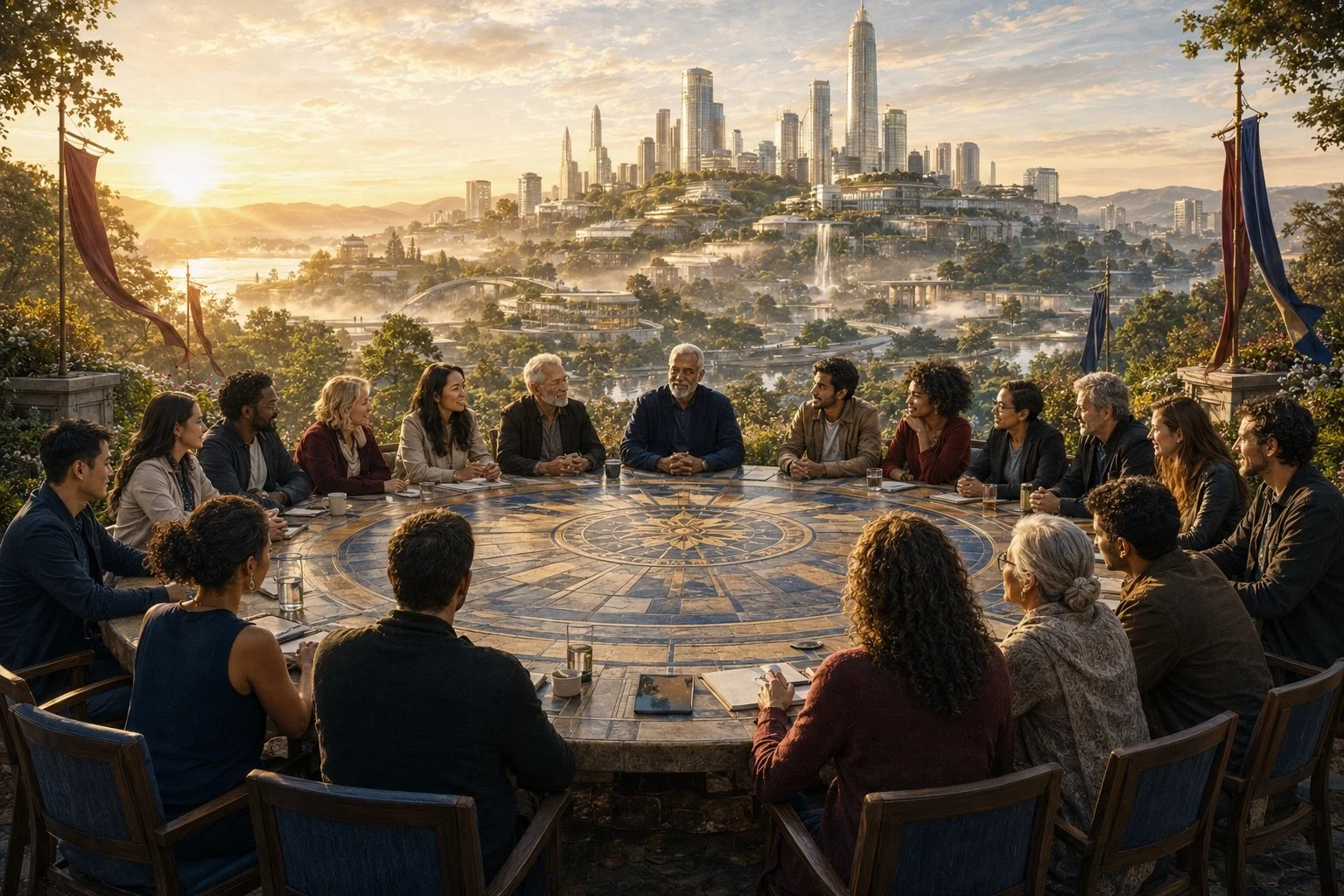
Camelot in our lives and organisations
Most of us have known more than one Camelot. It may have been a happy season in family life, a close friendship, a church, a workplace, a team or a cause that drew good people together. For a time, there was trust, energy and a shared sense that what we were doing truly mattered.
Looking back over my own working life, I can recognise three such Camelot periods. Each lasted for some wonderful years. Good people came together, a strong team was formed, and we did work that made a genuine difference. Together, we built something special.
And yet, in time, each of those seasons came to an end. Circumstances and relationships changed, pressures grew, fault lines appeared; and what had once seemed so strong began to unravel. I have watched the same thing happen in the lives of other leaders and organisations: years of courageous and worthwhile endeavour, followed eventually by fragmentation, disappointment or decline.
It seems that life—and everything we build within it—has seasons.
This does not mean that our Camelots were false or that the good years were somehow an illusion. We can be deeply grateful for what was achieved without pretending that it was perfect. Every Camelot is made of imperfect people. Even our best leaders have weaknesses. Even close companions can disappoint one another. Every community carries within it both the possibility of greatness and the seeds of its own undoing.
The challenge is to notice the cracks early: to tell the truth with kindness, to keep justice joined to mercy, and to ensure that our structures continue to serve people rather than asking people to serve the structures.
Organisations often begin with a dream and a small group of people who trust one another. In those early days, the founding story is alive. People remember why they began, what they hoped to change and what they were prepared to sacrifice.
As the organisation grows, however, rules and systems become necessary. New people arrive who did not live through the founding story. Roles become more specialised, relationships more complicated and decisions more distant from the original dream. Slowly, protecting the organisation’s reputation can begin to seem more important than facing what is really happening. Structures that once helped the organisation flourish may no longer fit the world into which it is moving.
This is part of Camelot’s final wisdom: no organisation, career, relationship or season of life remains forever in its original form. Some endings come naturally as people and circumstances change. Others come through conflict, failure or betrayal. But an ending does not mean that the effort to create something noble was wasted.
Camelot’s best values can outlive its fall. Courage can take a new form. Fellowship can gather around another table. The wisdom won through both achievement and failure can be entrusted to those who come next.
When a season ends, our task is not simply to preserve what was—or to hide what went wrong. We cannot renew Camelot merely by polishing the Round Table.
Renewal begins when we tell the whole story honestly: the dream, the achievements, the relationships, the fractures and the lessons. It asks us to face what has broken, acknowledge the limits of even our finest leaders, listen to those whose voices may have been overlooked, and make room for new people and new ways of working.
The meaning of Camelot is found not only in its glory or in its collapse, but in the tension between the two. The legend reminds us that every human achievement is fragile, that every community depends upon the quality of its relationships, and that every season of greatness must eventually prepare for what comes next.
We cannot remain forever within the brief shining moment. But we can remember it faithfully—not by pretending that it was perfect, or believing that everything good now belongs to the past, but by carrying forward what was most noble and learning honestly from what caused it to unravel.
The closing song from Camelot still moves me, especially its plea that the dream should not be forgotten:
Don't let it be forgot, that once there was a spot
For one brief shining moment that was known as Camelot.
The kingdom may fall, but the story can still be carried forward.
A final thought
When Arthur is young, he draws the sword. In maturity, he builds the table. At the end, he lets them both go so that the story can live beyond him.
What I take from Camelot is not a gloomy conviction that every great dream must eventually fail. It is something more hopeful.
Knowing that no season lasts forever does not release us from the dream. It makes the quest more precious. We must still answer the call to bring what light we can to this place and this time. We still gather people around the table because there is meaning and life in doing so. We still try to build something worthwhile, serve a purpose larger than ourselves and leave behind something that may uplift those who come after us.
The dream matters, even when it cannot be completed. The work matters, even when someone else must carry it forward. The brief shining moment matters, not because it lasts forever, but because for a time it shows us what might be possible.
As a saying by Rabindranath Tagore reminds us:
“The one who plants trees, knowing that they will never sit in their shade, has at least started to understand the meaning of life.”
Perhaps this is the enduring invitation of Camelot: to pursue the noble dream without needing to possess it forever; to plant what we may never see fully grown; and to trust that the courage, love and hope we bring to our own season may become part of someone else’s beginning.
Questions for personal reflection
1. What have been my own sword in the stone moments - times when life called me into a responsibility or possibility I did not yet feel ready for?
2. Who have been the Merlin figures in my life - people who saw something in me, encouraged me or helped me find my way?
3. What Camelots have I helped to build? When have people, purpose and opportunity come together in a brief shining moment?
4. What made those times feel so alive and worthwhile?
5. When did cracks, disappointments or divided loyalties begin to appear?
6. What parts of myself have I found hardest to face honestly?
7. Is there a sword, role, status or old identity that I am now being asked to lay down?
8. What have both my successes and disappointments taught me?
9. Who might be my Tom of Warwick - someone younger to encourage, mentor or make room for?
10. What part of my Camelot story is worth remembering and passing on?
Questions for organisations and leaders
1. What was the dream that first called this organisation or community into being?
2. Is power here mainly used to protect positions, or to serve people and purpose?
3. Who has a real place and voice at our Round Table? Who is still outside it?
4. Where is there a gap between the values we talk about and the culture people actually experience?
5. What hard conversations, disappointments or breaches of trust have we avoided?
6. Do our rules still help people and serve justice, or have some become rigid and self-protective?
7. What weaknesses could a Mordred exploit because we have been unwilling to face them ourselves?
8. What may need to end or change so that the deeper purpose can continue?
9. Are experienced leaders making room for others to rise, or still trying to remain the hero?
10. What story, values and hard-won wisdom should we pass to the next generation of leaders?
Continue exploring
Dean Phelan | Uplift Centre | Melbourne Australia