
SALT - Strategic Action Leadership Teams
A Strategic Action Leadership Team or SALT is a methodology for a team to wrestle with and work through an action plan in response to a challenge or question for which there is currently no immediate solution or right answer to.
A SALT is essentially an Action Learning Team and follows the principles originally outlined by Prof Reg Revans. This resource outlines the methodology and gives some examples of its use.
Further illustrations of specific church examples can be seen in Integrated Communities.

Be the Salt & Light Matthew 5:13–16
SALT
6 - 8 leaders
passionate about their church,
want to see a flourishing future,
prepared to meet regularly over the next 12 months to
develop new thinking and a implement a bold plan to
be the salt and light in their community
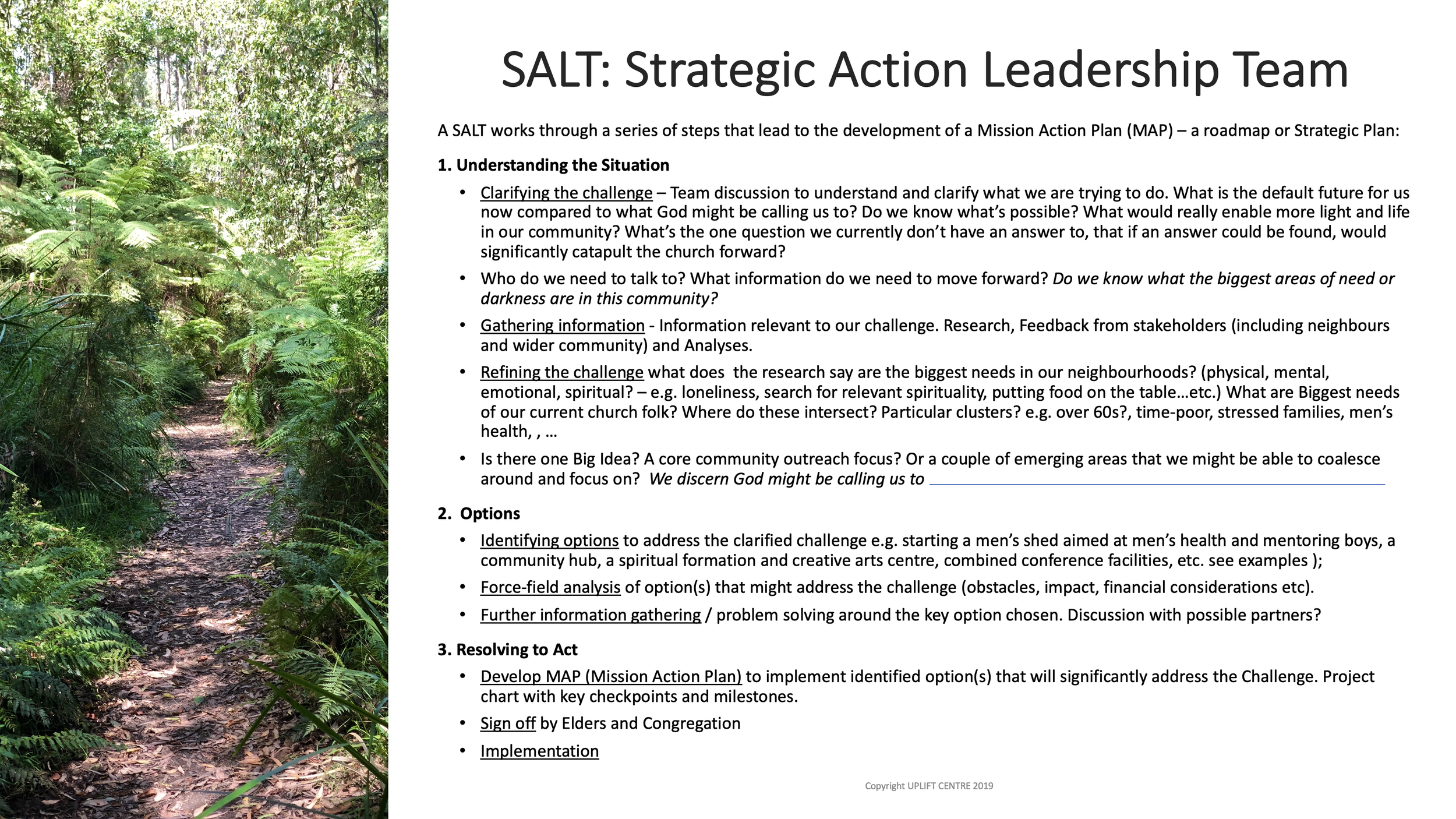
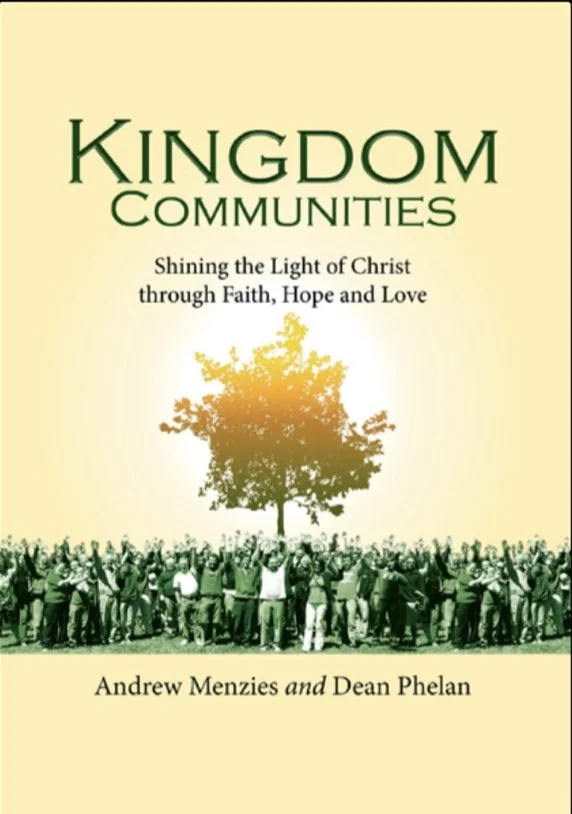
Extract from Chapter Six of Kingdom Communities - Shining the Light of Christ through Faith, Hope and Love by Menzies & Phelan, Morning Star Publishing 2018.
Describes the use of the SALT methodology by Dean Phelan and the Leadership Team of CofCQ. Dean was CEO of Churches of Christ in Qld 2010 - 2017.
FROM SILOS TO KINGDOM COMMUNITIES
“Don’t have people working in silos; have them working across the team.” - Patrick Lencioni
“For the body does not consist of one member but of many. If the foot should say, “Because I am not a hand, I do not belong to the body,” that would not make it any less a part of the body. And if the ear should say, “Because I am not an eye, I do not belong to the body,” that would not make it any less a part of the body. If the whole body were an eye, where would be the sense of hearing? If the whole body were an ear, where would be the sense of smell? But as it is, God arranged the members in the body, each one of them, as he chose. If all were a single member, where would the body be? As it is, there are many parts, yet one body.” - 1 Cor 12:14-20
The word silo comes from the ancient Greek word siros which was a pit for holding grain. Today we know silos as large structures that are usually above the ground but nevertheless have the same purpose; they hold grain and keep it separated from foreign material and hazards to the purity of the stock. A couple of these brief casestudies introduce us to the silos that Dean encountered in Queensland.
On one of his early travels Dean went to a town where Churches of Christ were providing aged care and child care services. The services happened to be located on land next door to each other. Dean noticed that the grass nature strip out front was mowed to a certain point and then not mowed beyond that. On enquiring about that situation, he was advised that aged care only paid for the grass to be mowed at the front of their place. Child Care was responsible for mowing the grass out the front of their place. As Churches of Christ Care owned both properties and ran both services, something was clearly amiss.
In 2011, many communities throughout Queensland were impacted by very significant floods. Many lives were lost and hundreds of thousands of homes, community facilities, livestock and food production were devastated. There were many extraordinary examples of people rallying to help out neighbours and strangers. It was a major crisis that affected not only Qld but impacted the food supplies across the nation. Churches of Christ in Queensland had industrial laundries and kitchens in most of their aged care facilities. In an attempt to mobilise the significant resources across Churches of Christ facilities in response to the emergency, Dean, backed by the Board, indicated that they should offer to take in muddy clothes, sheets and general laundry for local communities whose homes were impacted by the floods. This suggestion was met with resistance by several of the local service managers who asked; who was going to pay for it?
After being told to help each community where possible and to account for the additional cost separately, managers got on board and even began to take initiatives of their own such as making sandwiches for displaced children at a local school. A fundraising program was launched in parallel around Australia and funds poured in. The protectionist mindsets began to open up, but both of these examples reflected an underlying silo mentality within Churches of Christ in Queensland, largely driven by the system of budget setting and financial accountability processes that the organisation had set up.
The silo mentality was even enshrined in language at the time. One senior leader spelled out his view at an early Executive meeting, stating, “We (Churches of Christ in Queensland) do aged care, child care, housing and churches.” He was articulating four separate sets of services (that often didn’t communicate) which were clearly brought into alignment with the new mission statement, “We bring the light of Christ into communities.”
Prior to taking the role as CEO of Churches of Christ in Queensland, Dean practised as an organisational psychologist and founded a large consulting business. It was a rewarding and varied career and in addition to the substantial experiences he had at ministry and governance levels with Churches of Christ in Victoria and Tasmania, it prepared him well for the challenge of leadership in such a complex and transforming system of churches and care services.
In his professional practice Dean had a formative experience in 1995 when he was invited to participate in a week long gathering of Action Learning practitioners with Professor Reg Revans. Revans was not only a brilliant academic and Olympian but also was a pioneer of Action Learning, so it was a privilege to be with him and participate in the gathering of practitioners from around the world. The gathering was convened in London by Lord Butterfield, who was a very strong advocate for the work of Professor Revans and its potential to enable effective, large scale change.[1]
Dean was greatly influenced by that week, listening and discussing first-hand the principles that Revans used to revolutionise the coal industry in service of Britain’s World War II and post war demands. Revans subsequently moved to Belgium where he headed a national project aimed at raising Belgium’s productivity. Working with five universities and twenty-three of the country's largest businesses, Revans' collaborative approaches succeeded in raising Belgium's industrial productivity growth rate above that of the USA, Germany and Japan. Revans was subsequently awarded with the nation's top honour by the King of Belgium, and he was later nominated for the Nobel prize.
A central piece of Revans’ work was that managers learn best and produce better outcomes by engaging and learning from and with each other. He discovered that bringing together six to eight managers with shared experience in an area (for example, managers in a mine, ward managers in a hospital or experienced hands in a factory), who had some passion for solving problems and making things better in their area of work, led to real improvements on the ground. Levels of engagement, ownership, influence and practical gains were all significantly higher than the more traditional hierarchical or motivational approaches to change at the time.
Revans called these groups of team leaders ‘Action Learning’ groups. He found these Action Learning groups were best used for problems where there was no known or correct answer. It was in contrast to what he called ‘Programmed Knowledge,’ which was all the things that had a clear and correct answer (for example, the solution to a crossword puzzle, or the quickest route of travel from Adelaide to Perth). Revans spoke about areas of endeavour that required fresh questions and thinking. He asked questions like, what was the one question, that wasn’t currently known, that if an answer could be found, would significantly catapult the organisation forward?
Revans’ method of operation was to set up small groups in the workplace under investigation to pursue such questions. He empowered groups of six to eight practitioners with shared experiences and emotional involvement to significantly move things forward, by meeting regularly to discuss, experiment, share learnings and agree on ways of advancing and achieving breakthroughs. Revans is the author of a widely used saying, “There can be no learning without action, and no action without learning.”
Today many leading companies like Google, Space X, General Electric, Anderson Consulting, Whirlpool and the US Department of Defence employ models based on principles of Revans’ work. Some principles that underpin Action Learning include:
· Attacking problems (or opportunities) not puzzles. A problem has no existing solution whereas a puzzle has a right answer that isn't presently known (for example, a crossword).
· Posing questions from conditions of ignorance, risk and confusion, when nobody (including the experts) knows what to do next.
· Learning by doing, which means experimentation and risk must take place.
· Searching for reflection from experience. The major resources that any manager has are his or her experience and knowledge of the work situation. Learning by managers consists mainly in new perceptions of what they are doing and in their changed interpretations of their past experiences. It is not any fresh program of factual data, of which they were previously ignorant but which they now have at their command that enables them to surge forward.
Put simply, Action Learning is a process where people try out new ways of doing things relevant to a specific issue or project. They follow a process of observation and reflection about what happens, learn from it, and make modifications. It is a continuous and intentional process of learning from actions taken.
Action Learning on the Sunshine Coast.
In the previous chapter, we explored the first eighteen months of Churches of Christ in Queensland’s journey towards unity of mission and one common story. Once there was genuine ownership and commitment of the new mission (Bringing the light of Christ into communities) there needed to be a way to harness the enthusiasm and give legs to the energy around how the new mission would be implemented. Describing an attractive vision was important, but the words would become hollow unless there was a practical, on the ground strategy that engaged people to move ahead. The easier part of being a leader was to talk up a vision. The harder part was the implementation of strategies that encouraged and enabled people to actually move toward their preferred future. Talk was easy. The challenge before the leadership team was how were they going to bring more of the light of Christ into communities?
The experience on the Sunshine Coast was an important step forward. Having been explained by Dean, the leadership personnel concerned decided to use Revans’ model of Action Learning as a way of moving forward into the unknown. They initiated a small learning group to explore a possible way forward by inviting local leaders from the wider community, including local ministers, local care managers, and other passionate local leaders. These people were invited to come together to grapple with the question of how can Churches of Christ in Queensland enable more of the light of Christ to shine in that community (in this case the Sunshine Coast)?
This question was a good Action Learning question. It was not a puzzle that had a predetermined correct answer. There were any number of possible answers. Therefore, it was a challenge that needed to be wrestled with. The answer and implementation for that community, at that point in time, was interwoven with the commitment and passion of the people who answered the question and came up with a possible strategy.
The site of the Sunshine Coast was deliberately chosen as ‘low hanging fruit.’ There were three strong local churches and several well-regarded care services in the area. The then Senior Minister at Nambour Church of Christ was an early adopter of the idea and he had already built good relations with the neighbouring Church of Christ Sanctuary Park Seniors Village and developed active ministries engaging with the wider community. He championed the Action Learning group idea locally and encouraged the other local leaders to participate. So, eight local leaders started meeting for the first time to look at what Churches of Christ in Queensland might be able to do to enable more of the light of Christ to be shining on the Sunshine Coast, beyond the services that were already offered.
The Action Learning group was named a Strategic Action Leadership Team (SALT), which emphasised Jesus’ metaphor for why and how his followers should engage in missional presence: to be the salt of the earth and the light of the world (Matt 5:13-16).
The first thing the SALT discovered was that they had no common idea of what the major areas of darkness and need were on the Sunshine Coast. This was despite the fact that each of them provided particular services in the local area. Therefore, research was undertaken to determine what were local areas of need or darkness. Interestingly, men’s health emerged as a major issue, despite the sun and sea and apparent idyllic retirement destination of the Sunshine Coast. They learned that there was a hidden story of significant depression, mental and physical health needs and a high suicide rate amongst men. It was largely hidden because men would not talk about it or seek help but was well known to wives and healthcare professionals on the Sunshine Coast.
The idea for a men’s shed emerged from the SALT discussions. It was the first men’s shed for the region and was carefully and creatively designed as a way of creating a Kingdom Community with a focus on men’s mental health. Once the SALT agreed to the strategy there was high energy to roll out the men’s shed. Through brainstorming, cooperation and networking, spare land was identified next door to the Churches of Christ Care retirement village at Nambour. Through local contacts, a huge shed was donated by one of the big companies who had written it off after recent floods. Men from the churches and retirement village excitedly became involved, and a big hardware chain donated equipment through its community fund to support the fitting out being done by the team of volunteers. Incredibly, up to one hundred men (and supportive partners) became involved in the birth of a new Kingdom Community.
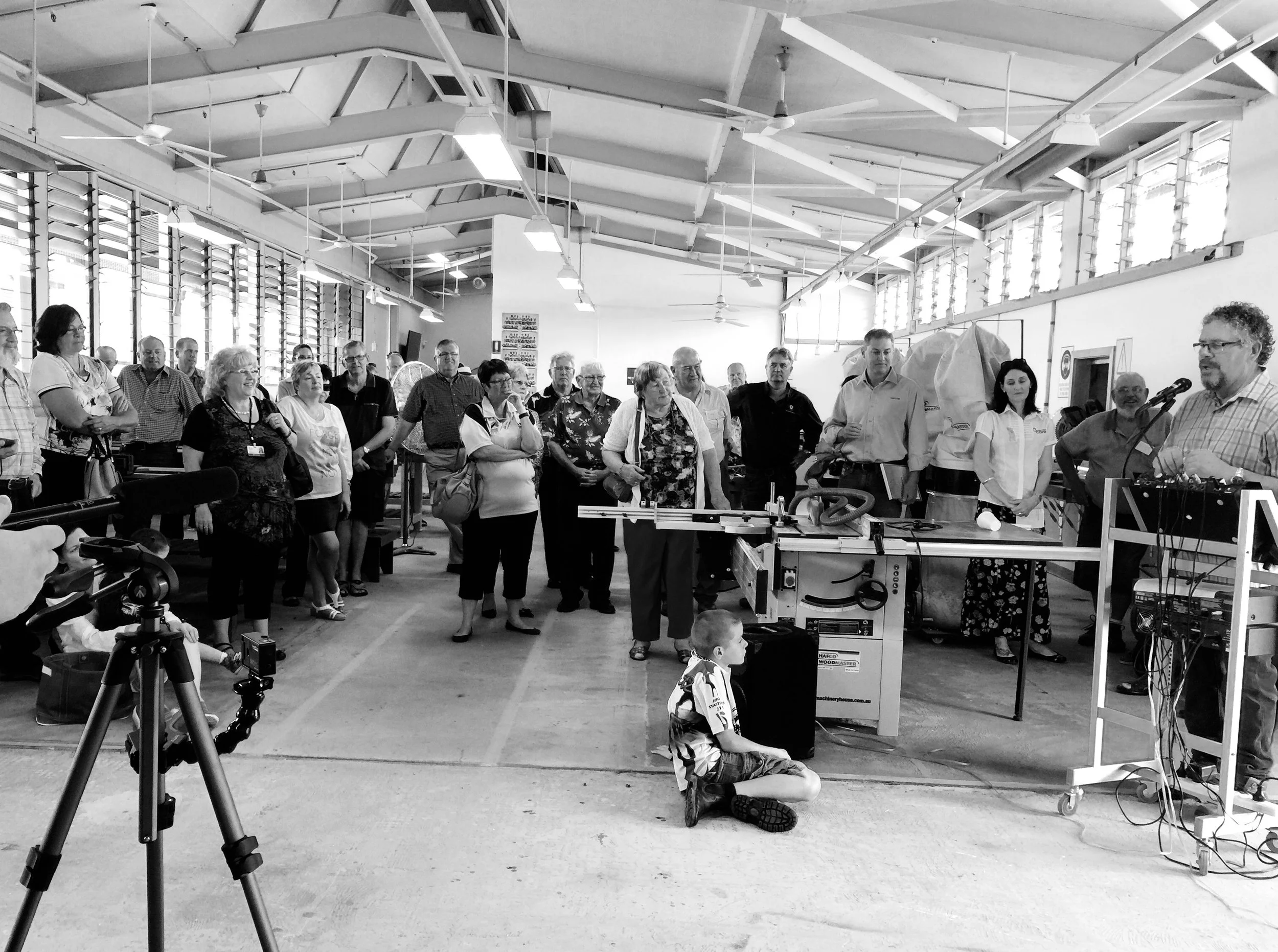
In the middle of this activity, a former church minister, Mark, emerged as a natural leader for the group. He felt that God was calling him to this work. He loved working alongside the guys. Mark was given a title of Mission Action Partner (MAP), as the role evolved into something more than being a chaplain, although it certainly involved chaplaincy. The role had an apostolic and entrepreneurial side to it, as part of Mark’s calling was to establish other men’s sheds and Kingdom Communities. He intentionally sought out others who could partner in order to enable more of the light of Christ to uplift and transform the lives of individuals, families and communities in other places.
Supported by the SALT, Mark had a huge impact and led the introduction of healthcare sessions through inviting local GPs and health professionals to come and talk at the shed about topics like prostate and bowel cancer and mental health matters. As relationships started to form, it became known that some blokes were doing it “real tough”. They were battling hard realties like depression, loss of the family farm following severe financial stress, or quietly battling cancer.
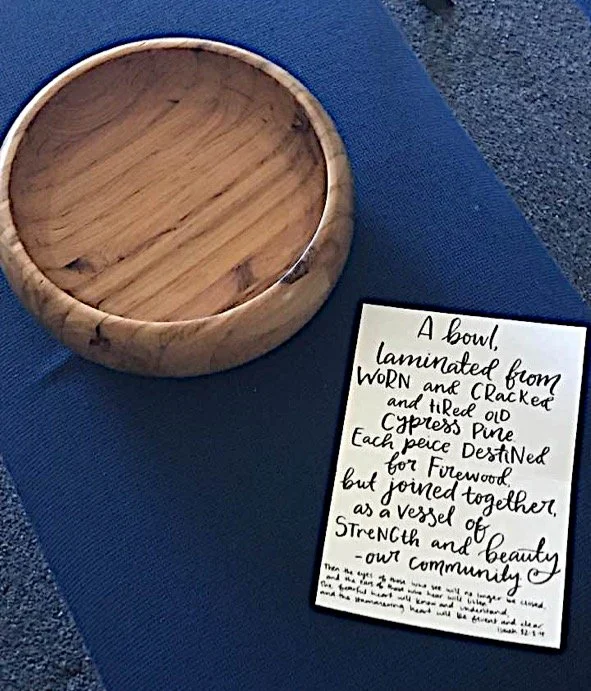
Mark suggested that prayers be offered in support of these guys and a regular prayer group naturally formed. Tim, the Senior Minister from the Nambour Church of Christ, was also actively involved and before long numbers started to swell at his church on Sunday mornings. The shed was not designed as a strategy to increase Sunday morning attendances, however, it seemed to naturally occur. A number of the men said that they went to Church years ago but had drifted away. They could relate to Mark, who was also a member of Nambour Church of Christ, and also to Tim, who happened to also be Chair of the SALT that established the men’s shed. Some men felt they wanted to bring their family back to reconnect again, as it was a place that was community minded, relaxed, relevant and caring.
The other interesting thing that happened was that the guys started making toy trains and doll houses to give to Churches of Christ child care centres along with many other projects. They also became involved in helping some of the farmers that were doing it tough, thus building further relationships and shining more light in the community. They decided to do a display stand at the annual Nambour Show to profile the men’s shed. An exercise book was available for anyone to put their contact details down if they were interested in joining. Over 200 put their details down.
This experience provided more community connection and growth in one year than Churches of Christ had witnessed anywhere in Queensland for two decades. It was catalysed by local leaders coming together because they were passionate about seeing what might be done to bring uplift and shine the light of Christ into one area of darkness in their community.
This work continued to grow with other men’s sheds commencing through the collaboration of local church and care service leaders across Queensland. In a few years Nambour, Mackay, Townsville, Bribie Island, and Toowoomba had men’s sheds running in collaboration with local churches and care services. The momentum generated by the shed gatherings and an expanding desire to shine the light of Christ to those doing it tough, also expanded to teams who provided food relief, practical help and pastoral care to farmers and rural communities affected by bushfires, drought and floods. Today, thousands of lives have been impacted in Queensland communities that would not have been reached through more traditional models of church alone.
Action Learning in Townsville.
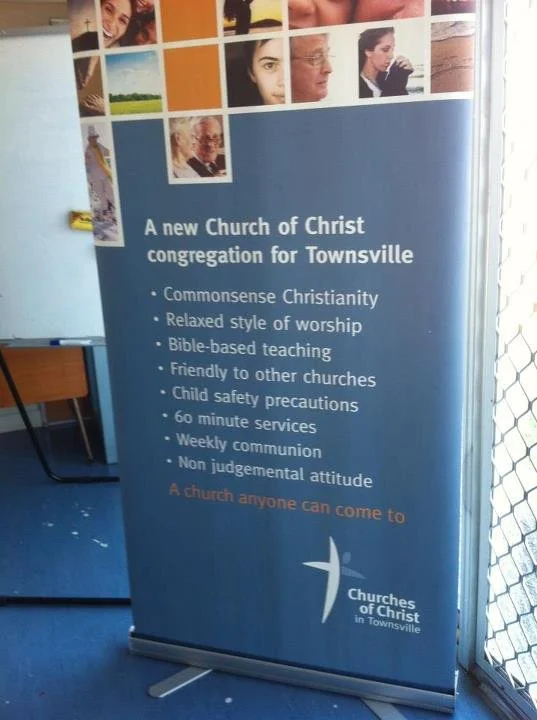
In North Queensland, a SALT was formed by local leaders from Churches of Christ in Queensland’s child, youth and family care services in the area, indigenous leaders and several people who were keen to birth a new faith community in Townsville.[2] Facilitated by Churches of Christ in Queensland’s new Executive Team, the Action Learning question was, ‘How can we best bring more of the light of Christ into the Townsville community?’
What followed was quite extraordinary. Having followed a process of wrestling and research, the Townsville SALT envisioned an integrated campus that would bring together all of Churches of Christ in Queensland’s services and active people onto one site. They dreamed of a campus that was big enough to invite other like-minded organisations to also come together onto one site. Churches of Christ care services had staff providing separate child, youth and family services out of rental premises across Townsville. There were also separate and unconnected efforts being made by Churches of Christ people with indigenous folk from the area. The SALT wanted to create a space where worship services could be held on the campus.
Because there was already better and integrated communication across the many areas (formerly silos) of Churches of Christ in Queensland, the property manager was made aware of a site that initially seemed way beyond what might be possible to purchase. It was originally a campus of James Cook University and had been sold to developers who subsequently went into receivership. The site had been unoccupied for several years. Churches of Christ were able to acquire the substantial campus, whose zoning was locked for community use, from the receivers for a greatly reduced figure.
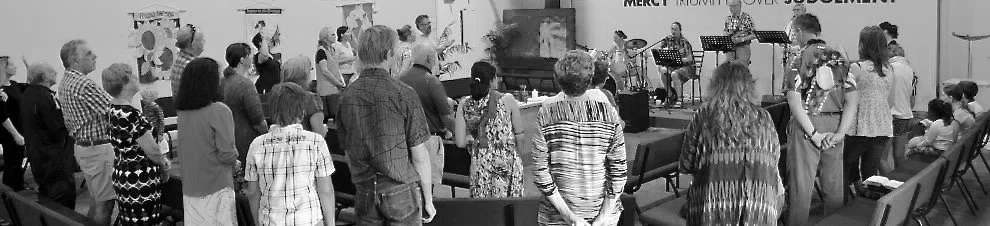
The site was made fit for purpose, and all of Churches of Christ in Queensland’s existing services were relocated onto the site. Church services were commenced in an old gymnasium space under the leadership of Barry, a Churches of Christ minister who had recently returned to Townsville from ministry in the USA. Despite having suffered a stroke, he offered to help out and eventually became the first minister and chaplain for the site, helping to shape a holistic Christian culture of the new campus.
Having established the new integrated campus, Churches of Christ in Queensland was soon after invited to take over a retirement village across the road which was experiencing financial difficulties. A deal was struck, and the group of elderly folk living in 120 units were successfully integrated into the wider community family with a sense of belonging and connectedness that they didn’t previously experience.
Arising out of the SALT’s discussions, a large men’s shed was built on the campus in one of the vacant buildings, and today is enthusiastically used by men from the church, retirement village, and many others in the community. Subsequent to the men’s shed they also opened a women’s shed! Also, suitably screened men are working in conjunction with the primary school across the road to provide mentoring for kids who do not have a dad.
These, and many other initiatives, all grew out of a SALT comprised of a group of local leaders who had a growing desire to enable more of the light of Christ to be shone in Townsville. In the space of a few years, Churches of Christ in Queensland had gone from having no local church and separate care services, provided out of different rented premises, to a thriving integrated Kingdom Community, providing a whole range of spiritual, mental, emotional and physical love and support to the wider community. Along the way other common mission organisations have also moved onto the campus, renting office space and contributing to the life of the community.

Today, the Churches of Christ’s Vincent Campus in Townsville is well known and regarded by the community and government and is seen as a major community presence in the area.
Shining more light.
Having commenced the initial SALT on the Sunshine Coast in 2011, by 2017 there were thirty SALTs operating in communities throughout Queensland. Each SALT was comprised of local leaders who were passionate about enabling more of the light of Christ to shine in their community. They were typically comprised of local Churches of Christ ministers, Elders and care service managers, but also increasingly local community representatives were also coming on board. For example, in two cases the local Shire mayors became members of the SALT for their community. Each SALT gathered together to research their region, in terms of current missional activity and also the opportunities for future mission. They each devised a Mission Action Strategy for their region. Mission Action Strategies were developed in conjunction with relevant specialist areas (for example, building development, finance, or government), provided with assistance of the Churches of Christ in Queensland Executive Team.
Many new Kingdom Communities (as described in chapter 5) have been established. Some look like local faith communities, as we have typically known them, coming together in fellowship to worship on Sunday and sharing Communion. Some look like men’s sheds. Some look like cafes on main streets, such as the Atherton Access Place described in the Introduction. All have the light of Christ shining through faith, hope and love.
[1] See https://www.actionlearningassociates.co.uk/action-learning/reg-revans/ and Reg Revans, ABC of Action Learning, Surrey: Gower Publishing, 2011. Also, David L. Dotlich, & James L. Noel, Action Learning: How the World’s Top Companies are Re-creating their Leaders and Themselves, San Francisco: Jossey-Bass, 1998, and William J. Rothwell, The Action Learning Guidebook: A real-time strategy for Problem Solving, Training Design, and Employee Development, San Francisco: Jossey-Bass Pfeiffer, 1999.
[2] There had previously been a Church of Christ local church in Townsville but it had folded following a number of years of difficulties. The 2010 Conference Council were very keen to see a new Church of Christ church rebirthed in Townsville.